
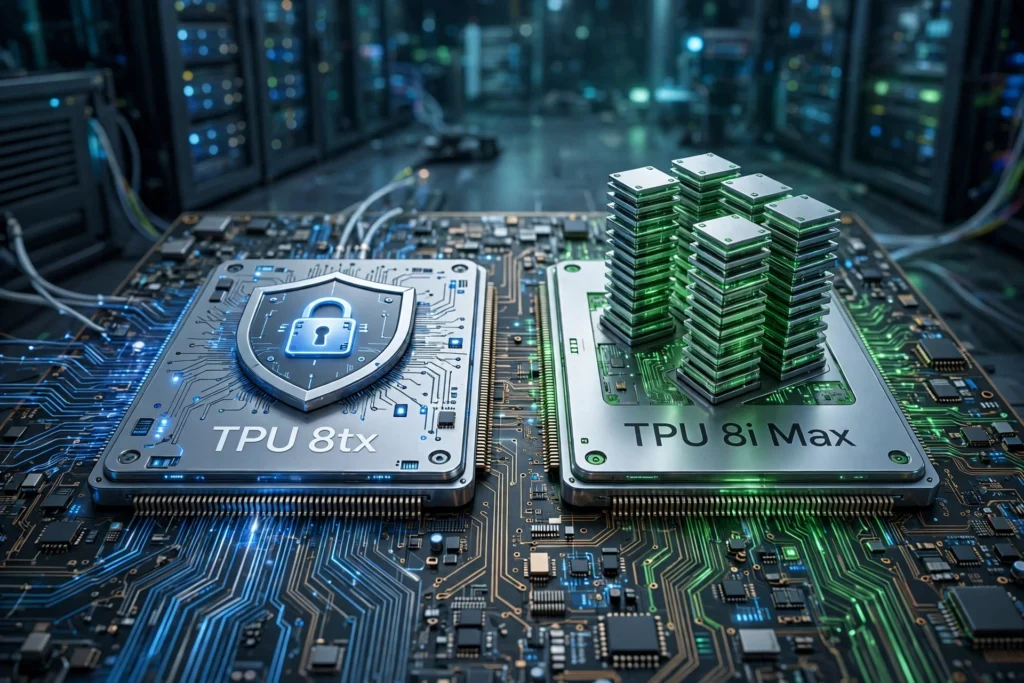
Google has introduced two new AI computing systems, TPU 8tx and TPU 8i Max, as part of its latest effort to expand its artificial intelligence hardware lineup. Announced on November 9, 2026, the systems are designed to address two growing demands in AI computing: protecting sensitive data during processing and handling workloads that require more memory.
The announcement brings Google’s eighth-generation Tensor Processing Unit (TPU) lineup to four systems. TPU 8t is built for large-scale AI training, while TPU 8i focuses on low-latency reasoning. The new TPU 8tx is designed for confidential AI workloads, whereas TPU 8i Max targets applications that need greater computing capacity and memory.
There is an important distinction, however: TPU 8tx and TPU 8i Max are new system configurations, not entirely new chip architectures. Both build on existing eighth-generation TPU silicon, with changes to the way the hardware is configured and packaged for different AI workloads.
What Are Google TPU 8tx and TPU 8i Max?
Tensor Processing Units, commonly known as TPUs, are specialised processors developed by Google to accelerate machine learning and artificial intelligence workloads.
Unlike general-purpose central processing units (CPUs), which handle a wide range of computing tasks, TPUs are designed specifically for AI-related processing. They can support tasks such as training neural networks and running trained models, depending on the system configuration.
According to Google’s official announcement, its eighth-generation TPU portfolio now includes four systems:
| TPU System | Main Purpose |
| TPU 8t | Large-scale AI model training |
| TPU 8i | Low-latency AI reasoning |
| TPU 8tx | Confidential AI inference and small-scale training |
| TPU 8i Max | Memory-intensive workloads and large context windows |
Google describes TPU 8tx and TPU 8i Max as new systems built around existing TPU technology, rather than completely new chip designs.
This approach allows Google to adjust computing, networking, memory and security configurations to address different customer requirements without designing an entirely separate processor architecture for each workload.
Google TPU 8tx: Designed for Confidential AI Computing
Google TPU 8tx is designed for organisations that need to run AI models alongside sensitive information. Google identifies regulated businesses and government organisations as potential users of the system.
One challenge in cloud computing is protecting information while it is actively being processed. Data can be encrypted while stored or transferred across networks, but conventional processing often requires it to be accessible in memory.
This creates a security concern for organisations using AI with private business records, proprietary models or other confidential information.
Google says TPU 8tx addresses this challenge through hardware-level confidential computing. The system uses the same silicon as TPU 8t and is paired with custom AMD CPU host infrastructure. Google says this design helps keep sensitive data and model weights protected and isolated while they are being used.
How AMD Supports TPU 8tx
AMD provides the host processors behind TPU 8tx. In its November 9 announcement, AMD confirmed that its fifth-generation EPYC processors power the system’s host infrastructure.
These processors manage tasks such as workload coordination, data preparation and communication with the TPU accelerators.
The system also uses AMD Secure Encrypted Virtualization (SEV) capabilities as part of its confidential-computing architecture. AMD explains that these capabilities, working with Google’s TPU and confidential-computing technology, help extend protection beyond the CPU to connected accelerators.
The security process includes checking an accelerator’s identity and security configuration before allowing access to protected memory. According to AMD, this helps protect customer prompts, model weights and intermediate data during processing and communication between the host and accelerators.
This is particularly relevant for organisations that want to use proprietary AI models and sensitive information without exposing those resources unnecessarily during computation.
However, hardware-level confidential computing does not automatically secure an entire AI application. Organisations still need appropriate access controls, software security, data governance and operational safeguards.
What Can Businesses Do With TPU 8tx?
Google identifies several workloads that TPU 8tx is designed to support, including:
- Running AI inference workloads involving sensitive information.
- Fine-tuning models using private business data.
- Distilling larger AI models into smaller models.
- Training AI agents through reinforcement learning.
- Running model customisation and inference workloads within the same system.
These capabilities may be useful in financial services, government operations and other regulated environments where data protection is an important requirement.
Google also says TPU 8tx uses its low-latency Boardfly network, which was developed for real-time reasoning workloads.
According to Google, TPU 8tx can deliver up to two times lower latency than TPU 8t, with a near-zero performance penalty. This is Google’s stated comparison between its own systems, not an independently verified result against competing AI processors.
Businesses exploring AI security should also read our guide to AI governance and business security, which explains the importance of protecting business systems and data.
Google TPU 8i Max: More Memory and Computing Power
While TPU 8tx focuses on confidential computing, TPU 8i Max addresses another challenge: the growing memory requirements of advanced AI workloads.
Modern AI agents may need to examine large software codebases, process lengthy videos or work with extensive amounts of contextual information. As these tasks become more complex, memory bandwidth can become a performance bottleneck.
Google refers to this challenge as the memory wall.
To address it, Google has combined two low-latency TPU 8i chips into a single package. The resulting TPU 8i Max system is designed to provide more computing capacity and memory resources for demanding AI applications.
According to Google’s technical announcement, TPU 8i Max provides the following improvements compared with TPU 8i:
- Twice the computing power.
- Twice the on-chip static random-access memory (SRAM).
- Twice the high-bandwidth memory (HBM) bandwidth.
- Twice the silicon within the existing rack footprint.
These are Google’s published comparisons with TPU 8i. They should not be interpreted as proof that TPU 8i Max is twice as fast in every application.
The additional memory bandwidth is intended to help processors access information more efficiently when handling demanding workloads. Google says the system is designed for massive context windows and higher computing density within data centres.
Why Does More Memory Matter for AI Agents?
AI agents often need to work with more than a single question or short instruction.
For example, a coding assistant may need to examine multiple files, understand relationships across an entire software project and retain relevant information while completing a task.
Similarly, AI systems working with lengthy videos or complex reasoning problems may need to process large amounts of information at once.
More computing capacity alone does not necessarily solve these challenges. Memory bandwidth and the speed at which information reaches a processor can also affect overall performance.
By combining two TPU 8i chips in one package, Google aims to increase computing resources and memory bandwidth together. The goal is to support larger workloads while using the existing rack footprint more efficiently.
Google’s announcement provides relative improvements over TPU 8i, but it does not establish how TPU 8i Max will perform against every competing processor in independent real-world tests.
Google TPUs vs Nvidia: What Does This Mean for AI Chip Competition?
Google’s latest announcement comes as demand for AI computing infrastructure continues to grow. Companies developing advanced models and AI agents need processors capable of handling increasingly complex workloads.
Nvidia remains a major supplier of AI graphics processing units (GPUs), which are widely used for AI model training and inference. Google, meanwhile, develops its own TPU hardware for internal workloads and customers using Google Cloud.
The two companies follow different approaches to AI computing. Nvidia offers a broad GPU ecosystem used by technology companies and cloud providers, while Google’s TPUs are specialised accelerators integrated into its infrastructure and cloud services.
The TPU 8tx and TPU 8i Max give Google additional configurations for customers with specific requirements, particularly confidential AI processing and memory-intensive applications.
Reuters reported that Google’s new systems are part of its broader effort to expand its position in the AI chip market and attract more enterprise customers.
However, Google’s announcement does not prove that TPU 8tx or TPU 8i Max outperform Nvidia’s latest GPUs overall. The published comparisons for these systems focus on Google’s own TPU configurations, rather than a direct independent comparison with equivalent Nvidia hardware.
The more meaningful question is whether Google’s systems can provide a suitable combination of performance, security, software support and cost for particular customer workloads.
For another example of AI technology in graphics, explore our coverage of Nvidia DLSS 5
When Will Google TPU 8tx and TPU 8i Max Be Available?
Google announced TPU 8tx and TPU 8i Max on November 9, 2026. The company has not provided exact public launch dates or pricing in its official announcement.
However, Google executive Amin Vahdat told Bloomberg that the two specialised systems are expected to become available in 2027. This availability timeframe was reported by Bloomberg journalist Dina Bass.
Businesses interested in deploying the systems will need to wait for further information about availability, pricing and deployment options.
Google is also working to make its TPU platform more accessible to developers. In its announcement, the company highlighted its open-source TorchTPU project, which brings native PyTorch support to its TPU ecosystem, alongside support for inference frameworks such as vLLM and SGLang.
These software developments matter because hardware availability is only one part of AI infrastructure adoption. Developers also need compatible software, documentation and practical deployment options.
For now, organisations interested in the new systems should follow Google’s official Cloud announcements for confirmed availability and pricing information.
What Google’s New TPU Systems Mean for the Future of AI
The introduction of TPU 8tx and TPU 8i Max shows how AI hardware is evolving beyond simply increasing processor performance.
Businesses increasingly need systems that can protect sensitive information, support longer AI contexts and handle workloads involving multiple autonomous agents. These requirements are creating demand for more specialised computing infrastructure.
Google is addressing two of these challenges through its latest TPU configurations. TPU 8tx focuses on confidential computing, while TPU 8i Max aims to reduce memory-related bottlenecks.
Neither announcement proves that Google has overtaken Nvidia or that the new systems will become the preferred option for every AI developer. Their practical value will depend on availability, pricing, software compatibility and performance under real-world workloads.
Nevertheless, Google’s expanded TPU portfolio adds two specialised systems to the growing AI infrastructure market.
Frequently Asked Questions
What is Google TPU 8tx?
Google TPU 8tx is an eighth-generation TPU system designed for secure and confidential AI inference, as well as small-scale training. It uses the same silicon as TPU 8t and pairs it with fifth-generation AMD EPYC host processors as part of Google’s confidential-computing architecture.
What is Google TPU 8i Max?
TPU 8i Max is a Google AI computing system designed for memory-intensive workloads and large context windows. It combines two TPU 8i chips into one package, providing twice the compute, SRAM and HBM bandwidth of TPU 8i, according to Google.
Are TPU 8tx and TPU 8i Max completely new chips?
No. Google describes them as new systems rather than entirely new chip designs. TPU 8tx uses the same silicon as TPU 8t, while TPU 8i Max combines two TPU 8i chips in a single package.
How is AMD involved in Google’s TPU 8tx?
AMD supplies fifth-generation EPYC processors for TPU 8tx host infrastructure. Its Secure Encrypted Virtualization capabilities also contribute to the confidential-computing architecture alongside Google’s TPU technology.
Does Google TPU 8i Max outperform Nvidia GPUs?
Google has not published an independent, direct comparison proving that TPU 8i Max outperforms Nvidia GPUs overall. Its announced performance figures compare TPU 8i Max with Google’s own TPU 8i system.
When will TPU 8tx and TPU 8i Max be available?
Google executive Amin Vahdat told Bloomberg that both systems are expected to become available in 2027. Google has not announced exact public launch dates or pricing in its official announcement.
Why are Google TPUs important for AI development?
Google TPUs are specialised processors designed for AI training and inference. Different configurations can address requirements such as large-scale model training, low-latency reasoning, confidential computing and memory-intensive AI workloads.
Sources
- Google Cloud – Our Newest TPUs: 8tx and 8i Max, Built for the Agentic Era
- Google – Introducing TPU 8tx and TPU 8i Max
- AMD – AMD EPYC Expands Its Leadership at the Foundation of AI
- Reuters – Google Unveils New AI Chip Variants as Cloud Demand Surges
- Bloomberg – Google Escalates Nvidia Rivalry With Specialized Versions of AI Chips
