
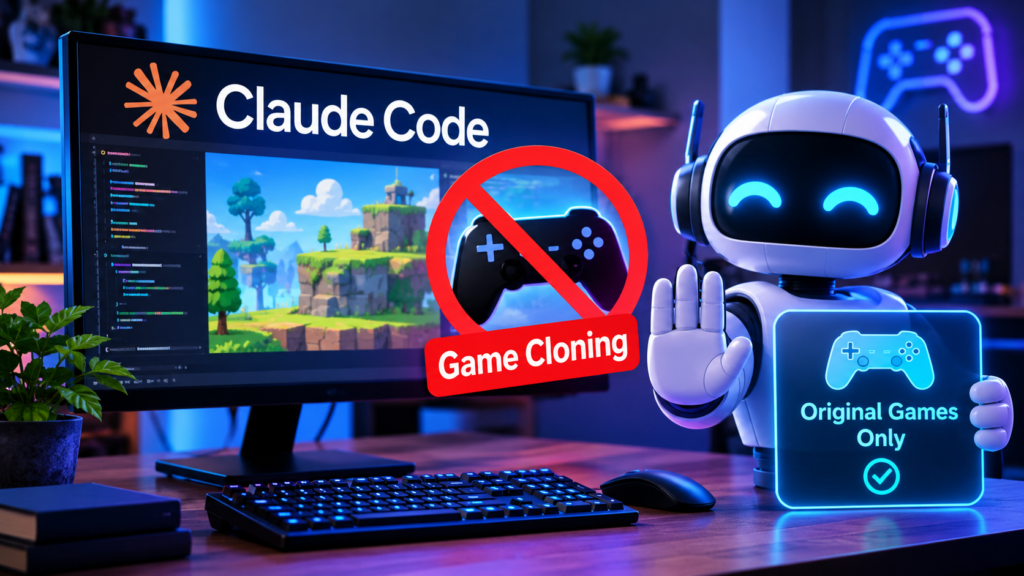
AI tools are making video game development easier in many ways. Developers can use coding assistants to test ideas, build prototypes, fix programming issues, and experiment with new gameplay features.
But there is another side to this technology. Some developers are concerned about Claude Code game cloning and the possibility of using AI to recreate existing games without the original creators’ permission. This could put independent studios at a disadvantage, especially when they have spent years working on their projects.
Anthropic has taken a step to address these concerns by updating Claude Code. The company confirmed that it added two sentences to the prompt used with its Opus 5.5 model, asking the AI not to recreate a specific existing video game.
This does not mean developers can no longer use Claude to make games. Anthropic says original projects, games based on familiar genres, and games built using a developer’s own designs and assets should still be supported.
The bigger question is how AI companies can help people create new games without making it easier to copy someone else’s work.
AI is already changing the gaming industry. Read our guide to AI in Video Games to explore how artificial intelligence is being used in modern game development.
What Changed in Anthropic’s Claude Code?
The change was first brought to public attention around October 27, 2026, when an X user known as Chasm reported finding new game-development instructions in Claude Code.
The reported instructions encouraged Claude to build original games, games within established genres, and projects based on a user’s own designs and assets. They also discouraged recreating a specific existing game, even if someone renamed it or described it as an original project.
Anthropic subsequently confirmed that it had made a change.
On October 30, Anthropic member of technical staff Addy Osmani explained that the company had added two sentences to Claude Code’s prompt on Opus 5.5. The purpose was to steer the assistant away from recreating another person’s specific game because using Claude to infringe intellectual property goes against the company’s usage policy.
Osmani also said that original games, genre-based projects, and games created using users’ own designs and assets were meant to keep working. He added that Anthropic would continue adjusting the approach to find the right balance.
It is important to distinguish between the reported prompt wording and Anthropic’s confirmed explanation. The company confirmed the addition of two sentences and their purpose, but the reported wording should not be treated as a separately published official policy document.
The update is therefore a restriction against helping recreate specific existing games, not a general ban on AI-assisted game development.
Why Is Anthropic Restricting AI Game Cloning?
AI coding assistants can make it easier to develop software and experiment with game ideas. Tasks that previously required considerable manual programming can sometimes be approached through natural-language instructions and AI-generated code.
That convenience also creates concerns when the technology is used to reproduce existing creative work.
For independent game studios, the issue can be particularly serious. Smaller teams may spend months or years developing a game, creating its visual identity, designing its mechanics, and preparing public demonstrations.
If someone uses an accessible demo or other material to create a competing copy, the original developers could face problems before their game even reaches the market.
Recent concerns involving independent studios illustrate why this issue has attracted attention.
Game Developer reported that Digital Sun Games changed its testing plans for ReVamp, its upcoming game. Instead of proceeding with a wider public playtest, the studio limited early testing to selected members of its Discord community because of concerns about potential AI-assisted copying.
The decision shows how fears about game cloning can influence the way studios share unfinished projects with players.
Anthropic’s update is one response to a wider debate about the responsibilities of AI companies when their tools are used to reproduce existing creative work.
What Games Can Developers Still Create With Claude?
Anthropic has said that its intention is to keep supporting original game development.
Developers can continue using Claude Code for projects based on their own ideas, designs, and assets. Creating a game within an established genre is also different from asking an AI assistant to reproduce a particular existing title.
The following examples illustrate the distinction described by Anthropic.
| Game development project | Anthropic’s stated direction |
| Building an original platform game | Intended to remain supported |
| Creating a new racing game concept | Intended to remain supported |
| Developing a puzzle game with original mechanics | Intended to remain supported |
| Using personal artwork and game assets | Intended to remain supported |
| Recreating a specific existing commercial game | Discouraged |
| Renaming a direct recreation to make it appear original | Discouraged |
These examples describe Anthropic’s stated direction. They are not a guarantee that Claude will accept every individual request.
Experimental AI platforms are also exploring new ways to make game creation more accessible. Google Playground AI is one example of a platform that lets users create games using natural-language prompts.
For example, a developer can ask Claude to help create a new platform game featuring jumping, obstacles, and collectible items. These are familiar elements of the genre and do not automatically make a project a copy of another game.
A different situation arises when someone asks an AI assistant to reproduce a particular game’s distinctive levels, characters, artwork, or other identifiable elements.
The distinction is between creating something original using familiar game conventions and attempting to recreate another developer’s specific work.
How Could This Affect Indie Game Developers?
Independent studios often operate with smaller teams and limited development budgets. AI coding assistants can help them experiment with concepts, develop prototypes, and work through technical challenges.
However, the possibility of AI-assisted copying introduces another concern.
Developers may become more cautious about sharing unfinished games publicly if they believe someone could use a demonstration or accessible build to create a competing version.
The ReVamp situation is a practical example. Digital Sun Games’ decision to restrict early testing shows how concerns about copying can affect a studio’s relationship with its potential player community.
Anthropic’s change may provide some reassurance to developers who use Claude Code. However, it cannot guarantee that their games will be protected from copying.
The restriction affects Claude Code’s relevant instructions. It does not prevent people from using other AI tools, conventional programming methods, or independent development processes to create similar projects.
For indie studios, protecting source code, original artwork, game assets, and unreleased development materials remains important.
Can Other AI Tools Still Create Video Game Clones?
Yes. Anthropic’s update does not automatically apply to every AI coding assistant.
Different AI companies have their own products, policies, and safeguards. Some developers may also use open-weight models or traditional programming tools that are not governed by Anthropic’s Claude Code instructions.
This is why one company’s restriction should not be viewed as a complete solution to AI-assisted game cloning.
In its November 2, 2026 coverage, Ars Technica explained that Anthropic’s change is unlikely to stop the wider spread of AI-assisted game copying. Other tools and development approaches remain available, which limits what a single provider can achieve through its own restrictions.
There is also a technical challenge: an AI assistant may not always be able to determine whether a developer is recreating someone else’s game or legitimately working on a project they own.
For example, a developer might ask Claude to help rebuild a prototype using their own source code and assets. Another developer might request help implementing a familiar gameplay mechanic as part of an original project.
These situations are not necessarily attempts to copy another game.
Anthropic has acknowledged the need to find the right balance. Osmani also invited users to share examples if Claude refuses to help with games that belong to them.
What Does This Mean for the Future of AI in Gaming?
Anthropic’s update highlights a growing challenge for the gaming industry.
AI is becoming a useful tool for software development, but its ability to reproduce existing creative work raises questions about originality, ownership, and responsible use.
Game developers want technology that helps them build projects more efficiently without making it easier for others to copy their work.
AI companies, meanwhile, need to decide how their products should respond when users request recreations of existing games.
The challenge is to support creative experimentation while respecting the rights of other developers.
Anthropic’s change is one example of how an AI company is attempting to address this issue through its coding assistant. Whether other providers introduce similar restrictions remains to be seen.
For now, developers can continue using AI to explore original game concepts, work on prototypes, and solve programming problems, while following the relevant tools’ policies and respecting applicable intellectual property rights.
Frequently Asked Questions
Has Anthropic banned making video games with Claude?
No. Anthropic has said that original games, projects based on established genres, and games created using a developer’s own designs and assets are meant to remain supported. The change is intended to discourage recreating someone else’s specific existing game.
When did Anthropic introduce the Claude Code game cloning restriction?
The new instructions were reportedly spotted around October 27, 2026. Anthropic confirmed the change on October 30, 2026.
Does the restriction apply to all Claude models?
The confirmed change specifically concerns Claude Code’s prompt on the Opus 5.5 model. It should not be described as a universal restriction across every Claude product or model.
Can developers still use Claude Code to create original games?
Yes. Anthropic has said that original games, genre-based projects, and games built from users’ own designs and assets are meant to keep working.
Why are indie game developers concerned about AI cloning?
Independent studios invest time and resources in original concepts, artwork, gameplay systems, and prototypes. They are concerned that AI tools could make it easier for others to reproduce their work without permission.
Will Anthropic’s restriction stop AI-generated game clones?
No. The change affects Claude Code’s relevant instructions. Other AI tools and conventional development methods remain available, so the restriction cannot eliminate game cloning across the industry.
Final Thoughts
Anthropic’s decision shows that AI-assisted game development is entering a more complicated phase. The discussion is no longer only about how quickly AI can generate code or help build playable prototypes. It is also about how these tools should respond when users ask them to recreate existing creative work.
For developers, the distinction matters: using AI to build an original game is different from asking it to reproduce another studio’s specific title.
Anthropic’s restriction is a step toward addressing that concern, but it is not a complete solution to game cloning. As AI coding tools become more capable, originality and intellectual property are likely to remain important issues for the gaming industry.
Sources
- Game Developer – Anthropic orders AI tool Claude to stop remaking video games
- Ars Technica – Claude’s new rules against game cloning won’t stop the AI copying boom
- The Verge – Anthropic clamps down on Claude’s AI video game clones
Information in this article reflects reporting available as of November 3, 2026. Product instructions and company policies may change.
