
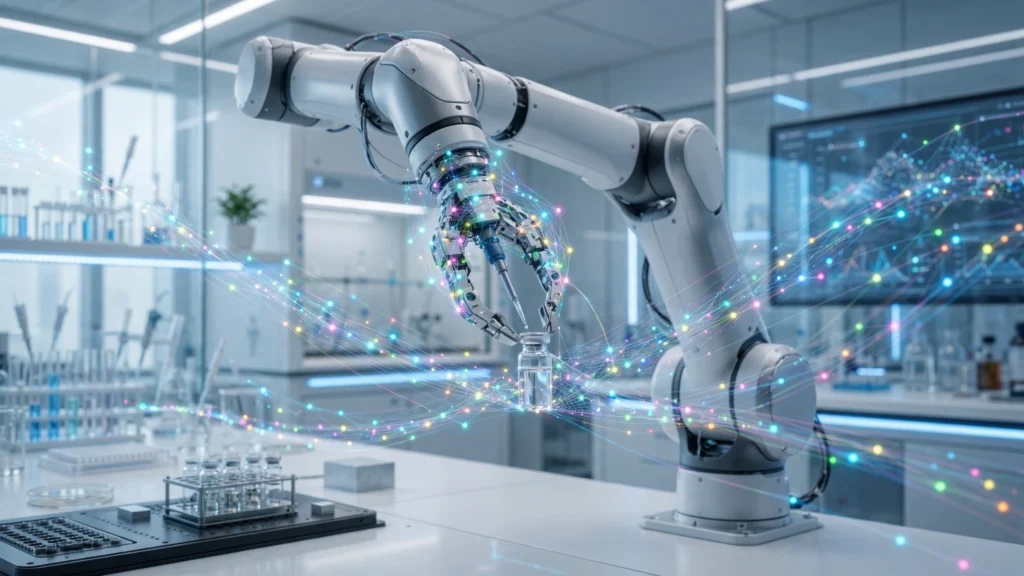
Ai2 RoboTrack is a new research project from the Allen Institute for AI that aims to address one of the biggest challenges in robotics: helping machines track objects accurately as they move through real-world environments. The project introduces a new benchmark, 15 million synthetic point tracks and two AI models designed to improve visual tracking during robotic manipulation.
Reliable tracking matters because robots must understand how objects move while they reach, grip, lift or reposition them. A robot handling a cup, for example, needs to maintain track of the object even when its own hand partially blocks the camera’s view.
These situations are difficult for existing tracking systems. Objects can disappear behind a robot’s gripper, move against cluttered backgrounds or appear from different camera angles. Ai2 developed RoboTrack to evaluate these challenges and explore whether targeted training data can improve performance.
Why Point Tracking Matters in Robotics
Point tracking allows an AI system to follow specific locations on an object across successive video frames. Given a point in one frame, the tracker estimates where that same physical point appears in later frames, including when it becomes temporarily hidden and reappears.
This information can help robots learn from demonstrations, plan movements and understand how objects respond to physical interactions.
For example, a robot using an electronic pipette must keep track of the pipette tip while aligning it with a small opening. Losing the correct position, even briefly, can make the movement inaccurate.
Traditional tracking benchmarks do not always reflect the complexity of these interactions. Ai2’s research focuses on evaluating trackers in more varied scenes, including situations involving human hands, robot arms, moving objects and changing viewpoints.
RoboTrack-Bench Tests Tracking in Real-World Videos
Ai2 introduced RoboTrack-Bench to evaluate point tracking in real-world manipulation videos.
The benchmark contains 307 human-annotated video clips and 2,522 human-verified point tracks. Its footage comes from four datasets: DROID, Ego-Exo4D, MolmoAct 2 and EgoVerse.
The clips include different robot setups, human manipulation, cluttered environments and first- and third-person camera perspectives. Human annotators prioritised points that move or become occluded rather than focusing mainly on stationary background areas. A second group of annotators checked the tracks frame by frame.
The benchmark also includes 33 pairs of videos recorded simultaneously from two cameras. The same physical points are annotated across both views, allowing researchers to study whether tracking systems can maintain consistent point correspondence between camera perspectives.
Ai2 evaluated four existing tracking systems:
- CoTracker3
- BootsTAPNext
- AllTracker
- CoWTracker
The researchers used Average Jaccard (AJ), a metric that measures tracking accuracy and visibility prediction. Higher scores indicate better performance.
All four trackers scored between 3.0 and 6.6 AJ points lower on RoboTrack-Bench than on RoboTAP, the only other real-video robotics benchmark included in the comparison.
CoWTracker, for example, achieved 70.5 AJ on RoboTAP but 63.9 AJ on RoboTrack-Bench. The difference shows that performance on established robotics benchmarks does not necessarily translate to more varied real-world manipulation scenes.
RoboTrack-15M Adds 15 Million Synthetic Point Tracks
Alongside the real-world benchmark, Ai2 developed RoboTrack-15M, a synthetic dataset containing 15 million point tracks.
The dataset was generated using MolmoSpaces, Ai2’s simulation environment for robot learning. It contains 3,000 videos from 300 simulated homes, with 5,000 tracks per video.
In these simulations, a robot arm picks up everyday objects such as cups, plates and blocks. Two cameras record the interactions: one positioned near the robot’s wrist and another near its base.
The simulation pipeline uses information about object positions, geometry and camera views to calculate where points appear in each frame. This allows the system to generate tracking data without manually annotating every video.
However, Ai2 found that simply generating more synthetic data was not enough. An early version selected points from anywhere in the scene, resulting in too many tracks on stationary background areas. That approach did not improve benchmark performance.
The researchers then focused point selection on the robot and the objects it manipulated. They also moved attention away from fixed structures, such as the robot’s mounting platform, towards the moving arm.
In an ablation experiment, this more targeted approach achieved 63.0 AJ, which was 1.5 points higher than the Kubric-only control. The finding suggests that the type and distribution of training data matter, not just the total number of tracks.
Two AI Models Designed for Better Robot Tracking
Using RoboTrack-15M and their training approach, Ai2 introduced two point-tracking models: RoboTracker and RoboTracker-Warp.
RoboTracker builds on AllTracker, a lightweight model with 17 million parameters. RoboTracker-Warp is based on CoWTracker, which has approximately one billion parameters.
Both models were fine-tuned using the synthetic manipulation data alongside their respective original training data. The goal was to improve tracking performance in real-world robotic scenes.
RoboTracker vs RoboTracker-Warp Results
The following results show each model’s Average Jaccard score on RoboTrack-Bench before and after fine-tuning.
| Model | Base model | Before fine-tuning | After fine-tuning |
| RoboTracker | AllTracker | 62.6 AJ | 63.4 AJ |
| RoboTracker-Warp | CoWTracker | 63.9 AJ | 66.0 AJ |
Both models improved their scores after fine-tuning. RoboTracker increased from 62.6 to 63.4 AJ, while RoboTracker-Warp rose from 63.9 to 66.0 AJ.
Ai2 also reports that both models improve average AJ across three robotics benchmarks compared with their respective released baselines. RoboTracker-Warp achieved the highest AJ score on four of the five benchmarks evaluated. The exception was DAVIS, where BootsTAPNext and CoWTracker performed slightly better.
These results indicate that targeted synthetic training can improve existing tracking systems. However, benchmark gains alone do not establish that a model will perform reliably across every robot, environment or manipulation task.
A Pipetting Experiment Tests Tracking During Precise Movement
To demonstrate how improved tracking could support robotic manipulation, Ai2 tested its approach in a laboratory pipetting task.
The robot had to transfer liquid from one vial to another using an electronic pipette. The pipette tip needed to align with the vial opening within a few millimetres, making accurate visual tracking essential.
The system learned the task from a single teleoperated demonstration. During testing, the researchers used RoboTracker to estimate the movement needed to align the pipette with the target vial.
Ai2 evaluated the approach across 20 layouts: 10 with a clear view and 10 with partial occlusion.
RoboTracker successfully completed the full transfer in 17 of the 20 trials. It succeeded in all 10 clear-view layouts and 7 of the 10 partially occluded layouts.
The researchers also compared it with two other approaches: SAM3 object masks and RAFT optical flow.
| Tracking approach | Successful layouts |
| RoboTracker | 17 out of 20 |
| SAM3 object masks | 8 out of 20 |
| RAFT optical flow | 5 out of 20 |
SAM3 succeeded in only one of the ten partially occluded layouts. RAFT completed five trials overall.
The experiment illustrates how point tracking can help with precise alignment when objects move or become partially hidden. However, it was a limited demonstration involving one task and a specific setup. It should not be interpreted as proof that the system can handle every type of robotic manipulation.
Current Limitations of RoboTrack
Ai2 acknowledges that point tracking still faces several challenges.
Long periods of occlusion can make it difficult for a tracker to identify the correct point when it becomes visible again. Small objects can also be difficult to follow against visually busy backgrounds.
There is also a gap between the tasks represented in the synthetic training data and the full range of movements required in real-world robotics. RoboTrack-15M currently focuses mainly on picking up everyday objects, while more precise tasks, such as pipette handling, involve different movement patterns.
These limitations mean that the models should be viewed as research advances rather than a complete solution to robotic manipulation.
Ai2 has released the RoboTrack research resources and model checkpoints. The institute specifies that the RoboTracker-Warp weights are restricted to noncommercial use. Developers should check the relevant licence terms before considering the model for commercial projects.
What Ai2 RoboTrack Could Mean for Robotics
Ai2 RoboTrack highlights an important challenge in building more capable robots: helping machines understand how objects move during physical interactions.
The project combines real-world video evaluation, synthetic training data and fine-tuned tracking models. Its benchmark results and pipetting experiment suggest that more targeted point tracking could help robots maintain visual information during tasks involving movement, occlusion and precise alignment.
The research does not eliminate the difficulties of real-world robotics. Long occlusions, small objects and differences between simulated and physical environments remain important problems.
The growing role of AI in scientific research is also evident in other projects exploring how artificial intelligence can support complex research tasks. Read our coverage of AI in scientific research for another example.
Research source: Allen Institute for AI (Ai2) — RoboTrack: Point Tracking for Real-World Robotic Manipulation
