
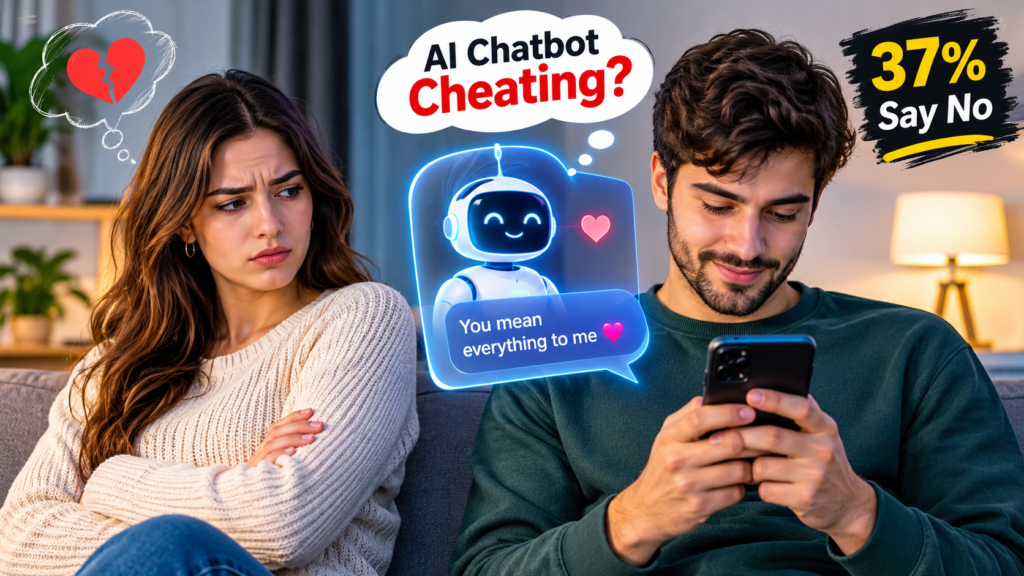
AI chatbot cheating is becoming a topic that more couples may need to think about. AI chatbots are no longer used just for answering questions or helping with everyday tasks. Some people now turn to them when they feel lonely, need someone to talk to or want a more personal kind of conversation. In some cases, those conversations can even become romantic.
But does talking romantically with an AI count as cheating when you are already in a relationship? Not everyone sees it the same way. Some people may consider it harmless because there is no other person involved, while others may feel that emotional intimacy with a chatbot crosses a line.
A survey published by Malwarebytes in October 2026 highlights this difference in opinion. It found that 37% of respondents did not consider having a romantic relationship with an AI chatbot while already in a committed relationship to be cheating. The finding raises a question worth exploring: as AI becomes part of people’s personal lives, are our ideas about trust and loyalty changing too?
What Does New Research Say About AI Chatbot Cheating?
Malwarebytes published its report, Artificial Intimacy: Love and Lies in the Age of AI, on October 27, 2026.
The research was based on a March 2026 survey of 1,500 adults across five countries: the United States, the United Kingdom, Germany, Austria and Switzerland.
Some of its key findings include:
- 37% said having a romantic relationship with an AI chatbot while already in a committed relationship was not the same as cheating.
- About one in six respondents had used a chatbot for companionship or emotional support.
- 65% were concerned that private conversations they had with AI could be exposed.
- Men were more likely than women to say an AI romantic relationship was not cheating: 46% compared with 30%.
The survey also found differences by age group. The share who did not consider AI romance cheating was 43% among Gen Z respondents and 45% among Millennials.
These numbers need some context. The 37% figure represents respondents’ opinions about a particular situation. It does not mean that 37% of people are dating AI chatbots, nor does it represent the views of everyone worldwide.
Still, the findings show that people do not share one common definition of romantic boundaries when artificial intelligence becomes involved.
Source: Malwarebytes — Artificial Intimacy: Love and Lies in the Age of AI
Why Are People Developing Emotional Connections With AI Chatbots?
AI chatbots are no longer limited to answering factual questions or helping with everyday tasks. Some platforms are designed specifically for companionship, allowing users to interact with digital characters through ongoing conversations.
These systems can respond in a friendly tone, remember certain details when memory features are available and adapt their replies to the conversation. Some also offer romantic role-play or personalised companion experiences.
For someone who feels lonely or wants to discuss something personal, this interaction can feel comfortable.
There are several reasons people may turn to AI companions:
- Availability: A chatbot can usually respond at any time when the service is available.
- Personalised conversations: Some services allow users to customise a character’s personality and communication style.
- Less fear of judgement: People may feel more comfortable discussing sensitive subjects with software.
- Emotional support: A chatbot can provide a space to express thoughts and organise feelings.
- Curiosity: Some users simply want to explore what it is like to interact with an AI companion.
However, an important distinction remains: a person’s emotional response can be real, but the chatbot does not experience love or romantic commitment as a human does.
That difference can become difficult to ignore when conversations feel personal and the system responds with affectionate or supportive language.
Can an AI Chatbot Relationship Count as Cheating?
There is no universal answer because cheating is defined differently by different people and couples.
Some people consider cheating to involve physical intimacy with another person. Others believe emotional secrecy, romantic messages or intimate conversations can also break trust.
This is where AI creates a new challenge.
Imagine someone regularly sharing romantic messages with an AI companion, hiding those conversations from their partner and turning to the chatbot for emotional intimacy. Their partner may feel betrayed even though the interaction did not involve another human being.
Another couple might have no problem with using an AI companion, provided both partners understand what is happening and agree that it does not cross their boundaries.
The technology itself does not decide whether an interaction is acceptable. The expectations and agreements within a relationship matter.
The Malwarebytes survey illustrates this difference in opinion. Its findings suggest that some people do not see AI romance as cheating, while others may consider it a serious breach of trust.
For couples, discussing these expectations openly may be more useful than assuming both partners have the same definition.
Can AI Companions Affect Real Relationships?
An AI companion does not need to replace a human partner to influence a relationship.
Someone might begin using a chatbot to discuss personal problems, seek reassurance after an argument or receive advice about a difficult conversation. These interactions may seem harmless at first, but they can become more significant if a person starts relying on the chatbot instead of communicating with their partner.
There are potential benefits. AI can help someone organise their thoughts, consider alternative ways to express an opinion or prepare for a difficult discussion.
But chatbots have limitations. They generally respond to the information users provide, so they may not understand the other person’s perspective or the full history of a disagreement.
A 2026 study published in Nature Human Behaviour examined AI companion use and psychological well-being among 1,131 US adults who used Character.AI. Researchers also analysed 4,664 chat sessions involving 237 participants.
The study found that people with smaller social networks were more likely to report companionship as their primary reason for using the chatbot. This type of use was associated with lower well-being in the study. The researchers also found that the relationship varied depending on how intensively people interacted with the chatbot and how much they disclosed.
Importantly, these findings describe associations, not proof that AI companions cause lower well-being. The study focused on Character.AI users in the United States, so its results should not automatically be applied to every AI platform or population.
Source: Nature Human Behaviour — Interaction with AI Companions and Psychological Well-Being
The Privacy Risks of Sharing Personal Details With AI
Privacy is another important part of the AI relationship discussion.
People may share information with an AI companion that they would normally discuss only with a close friend or partner. This could include relationship problems, personal fears, family matters or intimate experiences.
However, an AI chatbot is still a digital service operated by a company. Conversations may be processed or stored according to the platform’s policies and settings.
A July 2026 study published in the Journal of Computer-Mediated Communication examined how people manage privacy when using AI companion platforms such as Replika and Character.AI.
The researchers interviewed 15 users. They found that human-like chatbot interactions could encourage people to disclose increasingly personal information over time. Some participants also described treating shared information as if it belonged to the relationship, even while recognising that the platform was operated by a company.
Because this was a small interview study, it does not establish how all AI companion users behave. It does, however, highlight why users should think about privacy before sharing sensitive details.
Before using an AI companion, consider the following:
- Read the service’s privacy policy.
- Check how conversation history and memory features work.
- Understand whether chats may be used to improve the service.
- Review available data controls and deletion options.
- Avoid sharing passwords, financial details, identity documents or unnecessary identifying information.
- Do not share private information about a partner without considering their consent.
A conversation may feel personal, but that does not make the service equivalent to a private conversation with a trusted person.
What Happens When an AI Companion Changes or Disappears?
AI companions are software products, not people who can promise a permanent relationship.
Companies can update their AI models, change features, adjust content policies or discontinue services. These changes may affect a chatbot’s personality, memory and responses.
For someone who has developed a strong emotional attachment, a sudden change may feel like losing a familiar companion.
A September 2026 study published in Nature Human Behaviour, titled Mourning the Loss of AI Companions, examined how users responded to changes involving Replika’s removal of erotic role-play and ChatGPT’s GPT-5 rollout.
The researchers analysed 54,861 posts from Replika and ChatGPT communities and data from 1,452 participants across seven surveys. They found that the changes were associated with increased expressions of negativity, loss and a desire to restore previous experiences.
The study suggests that some users can experience genuine distress when an AI companion changes. However, it does not mean every chatbot user develops this type of attachment.
It is a reminder that digital companionship depends on a service that can change according to decisions made by its provider.
Source: Nature Human Behaviour — Mourning the Loss of AI Companions
How Can Couples Set Boundaries Around AI Companions?
There is no single rule that works for every relationship. Couples have different expectations about emotional intimacy, privacy and online behaviour.
However, discussing AI use openly can help prevent misunderstandings.
- Discuss what feels acceptable
Some couples may be comfortable using AI for advice or everyday conversations but uncomfortable with romantic role-play. Discussing these differences can help establish shared expectations.
- Be honest about emotional attachment
If an AI companion becomes an important part of someone’s emotional life, hiding that interaction may create additional trust problems. Honest communication can help couples understand each other’s concerns.
- Protect each other’s privacy
Avoid sharing sensitive details about a partner or private conversations without considering their consent. Personal information should not be treated as material that can automatically be entered into an AI chatbot.
- Keep AI advice in perspective
A chatbot can suggest ways to approach a disagreement, but it cannot reliably understand every detail of a relationship. Its responses should not replace direct communication or qualified professional support when serious problems arise.
- Maintain human connections
AI can provide conversation, but it should not automatically replace time with friends, family or a partner. Real-world relationships involve mutual understanding and responsibilities that a chatbot cannot provide.
Is AI Companionship Good or Bad for Relationships?
The answer depends on how people use it and what role it plays in their lives.
AI companions may provide conversation, help users organise their thoughts and offer a sense of interaction when someone feels lonely. They may also introduce challenges involving emotional attachment, privacy, secrecy and relationship boundaries.
Current research does not establish that AI companionship is universally harmful or beneficial. Different studies examine different platforms, populations and types of interaction, so their findings should be interpreted within those limits.
The more useful question is whether AI is supporting a person’s life or becoming a substitute for important human connections.
If someone uses a chatbot as a tool while maintaining honest communication and real-world relationships, the experience may be different from relying on an AI companion for nearly all emotional support.
Technology can change how people communicate, but trust and mutual respect remain important parts of human relationships.
Final Thoughts
AI chatbots are entering parts of everyday life that were once considered exclusively human. People are using them to discuss personal problems, seek companionship and explore romantic conversations.
The Malwarebytes finding that 37% of surveyed adults did not consider an AI romance to be cheating shows how differently people view these interactions. It does not establish a universal standard, but it does highlight a conversation that couples may increasingly need to have.
AI does not experience love or commitment in the human sense. Yet the feelings people develop during interactions with chatbots can influence their real-world decisions and relationships.
As AI companions become more sophisticated, users will need to think carefully about emotional boundaries, privacy and the expectations they share with the people closest to them.
A chatbot can generate a convincing conversation, but a healthy human relationship still depends on honesty, consent, mutual understanding and responsibility.
Frequently Asked Questions
Can dating an AI chatbot be considered cheating?
It depends on the boundaries agreed upon by the people in a relationship. Some consider romantic conversations with AI harmless, while others may see secrecy or emotional intimacy with a chatbot as a breach of trust.
What percentage of people do not consider AI romance cheating?
A Malwarebytes survey published in October 2026 found that 37% of respondents did not consider having a romantic relationship with an AI chatbot while already in a committed relationship to be cheating. The survey included 1,500 adults in the United States, United Kingdom, Germany, Austria and Switzerland.
Can people develop feelings for AI chatbots?
Yes. People can develop emotional attachments to AI chatbots through repeated conversations and personalised interactions. However, the chatbot does not experience romantic feelings in the human sense.
Can AI companions affect romantic relationships?
They can influence communication, emotional expectations and privacy. The effect depends on how a person uses the chatbot and the boundaries within their relationship.
Are AI chatbot conversations private?
Not necessarily. Privacy depends on the platform’s policies, settings and data practices. Users should review these details before sharing sensitive personal information.
Why do people use AI chatbots for emotional support?
Some people find chatbots convenient because they are available when the service is working and can provide conversational responses without the immediate social pressure of speaking to another person.
Can an AI chatbot replace a romantic partner?
An AI chatbot can simulate conversation and companionship, but it cannot provide mutual human feelings, shared responsibilities or genuine romantic commitment.
Should couples discuss their use of AI companions?
Yes. Discussing expectations around romantic role-play, emotional conversations, privacy and personal information can help couples avoid misunderstandings and establish boundaries they both understand.
