
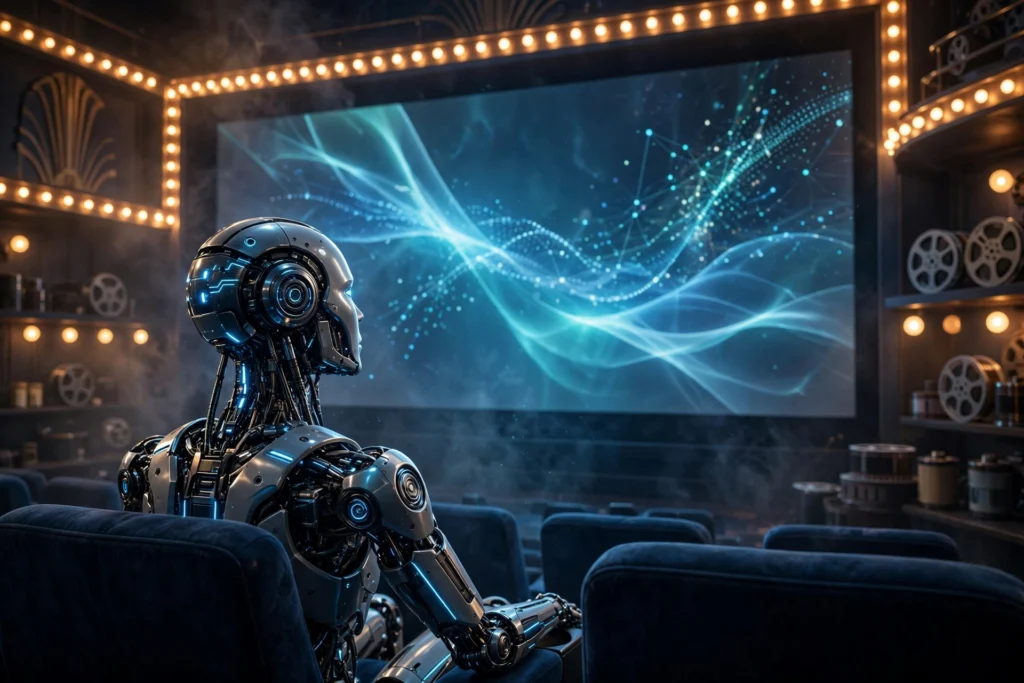
AI in Hollywood movies 2026 is changing everything we know about cinema. Let’s be honest, AI is no longer just a sci-fi topic, it is now part of how movies are actually made. Whether it’s creating digital actors, improving VFX, or helping with scripts, Hollywood is using it fast. And the best part is, new movies are also showing us the real side of this technology.
October 2026 offers three interesting films for examining this relationship: Klara and the Sun, The Social Reckoning, and Street Fighter. Although they approach technology from different perspectives, they highlight an important distinction: a movie featuring AI, a movie exploring technology’s social impact, and a movie made using AI tools are not necessarily the same thing.
For TechyToMore readers, understanding that difference is essential to following the future of entertainment.
1. Klara and the Sun: Exploring the Human Side of Artificial Intelligence
One of the most relevant AI-themed films of 2026 is Klara and the Sun, directed by Taika Waititi and based on the bestselling novel by Nobel Prize-winning author Kazuo Ishiguro.
Sony Pictures lists Jenna Ortega as Klara, an Artificial Friend designed to provide companionship. Klara meets Josie, played by Mia Tharia, and develops a relationship with her and her family. Amy Adams also stars in the film.
The movie is scheduled for theatrical release on October 23, 2026, according to the official Sony Pictures website.
What does the movie say about AI?
Unlike traditional science-fiction stories about machines taking control, Klara and the Sun explores questions about companionship, empathy, loyalty, and what it means to understand another person.
These themes are increasingly relevant as AI-powered assistants and conversational systems become part of everyday life. Modern AI can generate text, recognize patterns, and respond to human language, but convincing communication does not automatically establish that a system experiences feelings as humans do.
Klara’s fictional role provides an opportunity to consider this distinction. Can a machine provide meaningful companionship? How should people treat artificial companions? And what happens when technology becomes involved in deeply personal relationships?
The film’s story raises these questions without proving that real-world AI possesses human emotions.
Official source: Sony Pictures — Klara and the Sun
2. The Social Reckoning: AI, Algorithms, and Digital Responsibility
The Social Reckoning, written and directed by Aaron Sorkin, is another notable October release. Sony Pictures announced its theatrical release for October 9, 2026.
The film is a companion piece to The Social Network and draws inspiration from the Facebook Files investigation. Its story follows whistleblower Frances Haugen, played by Mikey Madison, and journalist Jeff Horwitz, played by Jeremy Allen White.
The film examines concerns about social media companies, internal information, and the consequences of technology platforms’ decisions.
Why is this relevant to artificial intelligence?
Social media platforms use algorithms and automated systems to rank content, personalize recommendations, and determine what users see. Some of these systems incorporate machine learning, although not every algorithm is an AI system.
These technologies can influence the spread of information and shape users’ online experiences. Questions about transparency, privacy, harmful content, and accountability therefore remain important.
However, it is important not to describe The Social Reckoning as an AI-focused film without qualification. Its central subject is the broader impact and responsibility of social media platforms. Its themes connect to AI ethics, but that is different from confirming that the film focuses specifically on generative AI.
The movie provides a useful starting point for discussing how technology companies should balance innovation, user safety, and public responsibility.
Official source: Sony Pictures — The Social Reckoning
3. Street Fighter: The Connection Between Gaming and Cinema
The live-action adaptation of Street Fighter is scheduled for release on October 16, 2026, according to Paramount Pictures and Legendary Entertainment.
The film stars Andrew Koji as Ryu, Noah Centineo as Ken Masters, and Callina Liang as Chun-Li. Its cast also includes Jason Momoa, Roman Reigns, and Cody Rhodes.
The story follows familiar characters from the fighting-game franchise as they enter a new World Warrior Tournament.
Where does AI fit into gaming adaptations?
Video game adaptations often require extensive visual effects, detailed environments, digital characters, and carefully coordinated action sequences. AI-assisted tools may have applications in some of these production areas, depending on the project and the tools selected by the filmmakers.
Nevertheless, the presence of digital effects does not prove that a production used generative AI. Traditional visual-effects software, motion capture, animation, and computer-generated imagery are established techniques that do not automatically involve generative AI.
No claim that Street Fighter specifically relied on AI-powered visual effects or AI-generated fight choreography should be published without a reliable production source confirming it.
The film is still relevant to the wider discussion because it illustrates the continuing relationship between gaming, digital entertainment, and Hollywood filmmaking.
Official sources: Paramount Pictures — Street Fighter and Legendary Entertainment — Street Fighter
How Artificial Intelligence Is Changing Filmmaking in 2026
Beyond individual movie stories, AI raises practical questions about how films are developed and produced. Its potential applications include several areas of filmmaking.
1. Visual effects and digital characters
AI-assisted tools can support certain image-processing, cleanup, and digital-production workflows. Depending on the application, they may help artists handle repetitive tasks or explore visual possibilities.
However, AI is not a replacement for every visual-effects technique. Complex scenes still require creative decisions, technical supervision, and quality control.
2. Editing and post-production
Some AI-powered applications can assist with transcription, footage organization, subtitle generation, and other post-production tasks. These functions may reduce manual work and help teams manage large amounts of material.
There is no verified public evidence cited here that Klara and the Sun used AI to edit emotional scenes or that its editing process lasted 19 months. Those specific claims should be omitted unless confirmed by the filmmakers or production company.
3. Script development and creative planning
AI tools can generate ideas, summarize documents, and help organize research. Filmmakers may experiment with these capabilities during early planning, but their usefulness varies.
It is also misleading to state that Hollywood studios routinely use AI to predict exactly which scenes audiences will love. Audience behavior is complex, and no tool can reliably guarantee a film’s success.
4. Digital replicas and performer rights
One of Hollywood’s most significant AI debates concerns digitally recreating actors’ faces, voices, and performances.
SAG-AFTRA has published guidance on AI and digital replicas, including contractual protections involving performer consent and compensation. These issues demonstrate why the industry’s AI discussion is not just about efficiency: it also concerns ownership, employment, privacy, and creative rights.
Reference: SAG-AFTRA — Artificial Intelligence Resources
Final Verdict: Hollywood’s AI Future Is About More Than Technology
AI in Hollywood movies in 2026 represents two connected developments. Films such as Klara and the Sun explore the human questions raised by artificial intelligence, while discussions about production tools highlight the technology’s potential impact on the filmmaking process.
The Social Reckoning broadens the conversation to the social responsibilities of technology companies, and Street Fighter demonstrates how video game franchises continue to move into cinematic entertainment.
The important lesson is to separate a film’s fictional portrayal of AI from verified evidence about the tools used to produce it. As filmmaking technology develops, reliable reporting will matter just as much as exciting headlines.
For more coverage of artificial intelligence, science, gaming, and entertainment, keep following TechyToMore.
Frequently Asked Questions
What are the major AI-related Hollywood movies in 2026?
Klara and the Sun directly explores artificial companionship. The Social Reckoning examines social media and technology’s consequences, while Street Fighter represents the intersection of gaming and cinema. They do not all have the same relationship with AI.
When is Klara and the Sun releasing?
Sony Pictures lists October 23, 2026, as the film’s announced theatrical release date.
Is The Social Reckoning about artificial intelligence?
The film focuses on social media, corporate accountability, and the Facebook Files story. Its themes connect to algorithmic responsibility, but it should not be described as exclusively about AI.
Is Street Fighter using AI-generated visual effects?
The official sources cited in this article confirm the film’s release information and cast, but they do not establish that the production used AI-generated visual effects. A specific claim would require further verification.
How is AI used in filmmaking?
Potential applications include image processing, visual-effects workflows, transcription, footage organization, and other production tasks. The tools used vary by project, and AI use should be confirmed rather than assumed.
Can AI replace Hollywood actors?
AI can generate synthetic content and digital replicas, but replacing human performers raises significant creative, contractual, and ethical questions. SAG-AFTRA’s AI guidance explains protections involving consent and compensation for digital replicas.
