
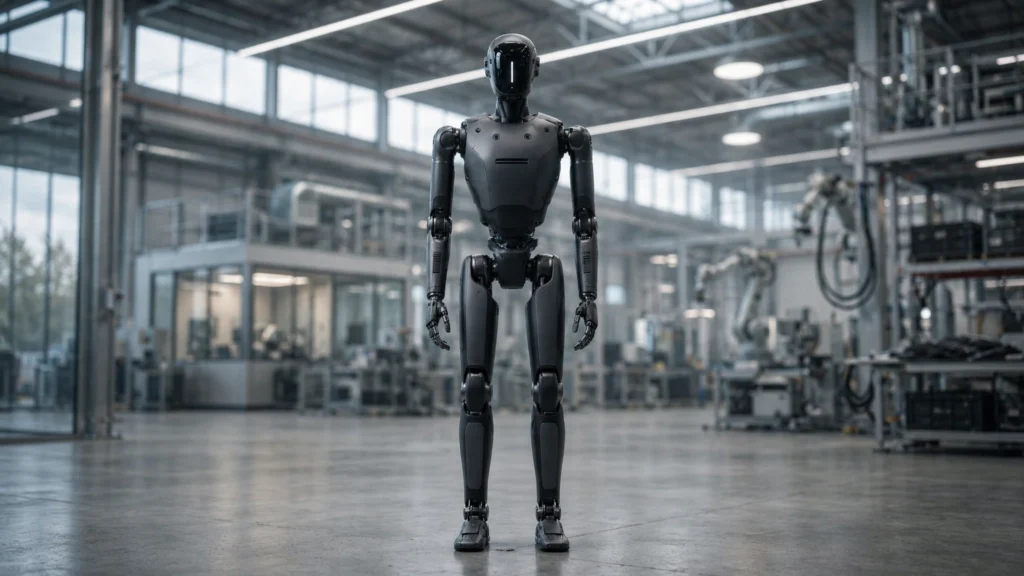
The Phantom MK1 is a humanoid robot developed by US-based Foundation Future Industries for industrial work and potential military applications. Unlike consumer-focused humanoid robots designed to assist in homes or public spaces, Phantom has attracted attention for its proposed role in handling dangerous tasks, including moving supplies and operating in high-risk environments.
The robot has become part of a wider debate about the future of military robotics. In November 2026, Foundation’s co-founder said the company was in discussions with the Israeli military about potential use of its humanoid robots in tunnels beneath Gaza. The discussions have raised questions about the use of robotic systems in combat, the level of human control involved and the technology’s actual capabilities.
What Is the Phantom MK1 Robot?
The Phantom MK1 is a bipedal humanoid platform developed by Foundation Future Industries, a robotics startup based in San Francisco, California.
The company has positioned the robot for work in industrial environments, warehouses and potential military settings. Its human-like structure is intended to let it operate in spaces designed for people, potentially allowing it to handle equipment and materials without requiring facilities to be redesigned around specialised machinery.
Foundation has also demonstrated the Phantom MK1 handling a mortar round in promotional footage. The demonstration shows the robot interacting with a military object, but it does not establish that the machine can independently operate weapons or perform combat missions.
Phantom MK1 Specifications and Conflicting Figures
Published specifications associated with the Phantom MK1 describe a full-size humanoid platform designed for physically demanding tasks.
Some published listings give the following figures:
- Height: approximately 1.8 metres
- Weight: approximately 80 kilograms
- Maximum payload: up to 40 kilograms
- Degrees of freedom: 29
- Maximum speed: approximately 1.7 metres per second
However, other Foundation-related product listings and technical descriptions report different figures, including a height of around 175 centimetres, a continuous payload capacity of 20 kilograms, a maximum payload of 36 kilograms and 19 upper-body degrees of freedom.
These differences make it important to treat the published specifications cautiously. The figures may reflect different configurations, measurement methods or revisions to the robot. Foundation has not provided a single, consistently documented specification set that resolves every discrepancy.
The payload distinction is particularly important. A maximum lifting figure is not necessarily the same as a load the robot can carry continuously during normal operation.
Foundation’s Reported Talks With the Israeli Military Over Gaza
One of the most significant developments involving the Phantom MK1 emerged on November 11, 2026.
Foundation Future Industries co-founder and president Mike LeBlanc told the Financial Times that the company was in talks with the Israeli military about using its humanoid robots for patrol duties in tunnels beneath Gaza. The discussions reportedly included the possibility of supplying as many as 1,000 Phantom robots.
LeBlanc said the proposed applications could include detecting trip wires, identifying booby traps and eventually performing combat-related tasks. The Israeli Defence Ministry declined to comment when approached by the Financial Times.
The report described preliminary discussions, not a completed supply agreement. There has been no public confirmation that the Israeli military has purchased the robots or that Phantom MK1 units have been deployed in Gaza.
The proposal has raised serious questions about the role of humanoid robots in military operations, particularly in confined underground environments where soldiers face significant risks. It also highlights the ethical and legal concerns surrounding machines that could be used in situations involving lethal force.
What Happened During the Reported Ukraine Testing?
Before the Gaza discussions became public, Foundation had said that two Phantom humanoid robots were sent to Ukraine in February 2026 for testing. Reports described the programme as focused mainly on logistics and other support tasks rather than direct combat.
The reported trials highlighted the potential of humanoid robots to move supplies in dangerous areas. They also raised practical questions about battery life, payload capacity and weather resistance.
There is, however, uncertainty around the deployment. Later reporting raised questions about whether the robots actually reached Ukraine. Independent journalist Craig Smith said the machines were stopped at the Polish border, while Foundation’s co-founder subsequently described a pilot demonstration at an undisclosed location without clearly resolving the question.
As a result, the available public reporting does not establish a verified record of sustained frontline deployment. The Ukraine story should be understood as a company-reported testing programme surrounded by unresolved questions, not as confirmed evidence of a combat-ready robot.
Is the Phantom MK1 Autonomous or Human-Controlled?
The Phantom MK1 should not be described as either completely autonomous or entirely human-piloted. Its control system has different levels of autonomy depending on the task.
In a February 2026 Reuters report, Foundation founder and CEO Sankaet Pathak said the robot’s walking and basic whole-body movement system could operate autonomously. He also described more advanced task execution as an area still under development.
Reuters footage showed the Phantom being teleoperated by a person wearing a virtual-reality headset, particularly during demonstrations involving arm movements. This illustrates that human operators remain part of the robot’s control process for at least some tasks.
Pathak also said that the company intended to retain human direction for weapon-related actions. The distinction is important: autonomous movement does not mean that a robot can independently make combat decisions or use weapons.
For any proposed military deployment, the precise balance between autonomous navigation, remote operation and human authorisation would need to be clearly established.
The Limitations of Humanoid Robots in Military Environments
Military environments present challenges that are substantially different from controlled factory demonstrations.
Battery endurance is one concern. A robot that needs frequent charging or human intervention may struggle to support operations over long periods.
Weather protection is another issue. Rain, mud, dust and water exposure can affect sensors, motors and electronic components. Earlier reporting on Phantom’s testing also identified limitations in its ability to operate in harsh outdoor conditions.
Communications create further risks for teleoperated systems. A robot that depends on a remote operator may lose functionality if its connection is disrupted. Autonomous navigation can reduce some communication requirements, but it does not remove the need to test how the machine responds when sensors provide incomplete information or unexpected situations arise.
These limitations help explain why the practical military value of humanoid robots remains an open question.
Foundation Future Industries Faces Financial Pressure
The technology is not the only challenge facing Foundation Future Industries.
In November 2026, Reuters and other technology publications reported that the company had stopped paying employees in recent weeks, citing internal communications from its leadership. The reports described the company as facing financial pressure while seeking additional investment.
Reuters reported on November 19 that South Korean conglomerate Base Group was preparing to invest $150 million in Foundation. A Base Group spokesperson confirmed that the company was considering an investment, but the report did not establish that the funding had been completed.
The funding discussions are significant because developing full-size humanoid robots requires substantial investment in hardware, software, testing and manufacturing. A company’s ability to finance development can be just as important as its technical progress.
The situation also attracted attention because Eric Trump, son of US President Donald Trump, serves as Foundation’s chief strategy adviser and holds an equity stake in the company, according to reporting cited by Reuters.
The reported financial difficulties do not by themselves establish that Phantom development will end. They do, however, add uncertainty to the company’s ability to scale its robotics programme.
What the Phantom MK1 Means for Military Robotics
The Phantom MK1 illustrates how humanoid robotics companies are exploring applications beyond factories and warehouses. Its proposed use in Gaza tunnels has brought the technology into a particularly sensitive area of military planning.
The potential benefits of robotic systems include reducing the need to send personnel into certain dangerous environments. However, the technology also raises difficult questions about reliability, remote control, accountability and the use of force.
A robot that can walk through a controlled demonstration or carry an object is not automatically capable of operating safely in a complex military environment. Independent testing, clear evidence of performance and transparent information about human supervision would be necessary to assess its readiness.
For now, the Phantom MK1 is best described as a humanoid robotics platform under development, with reported testing and proposed military applications. The discussions involving Gaza are significant, but they should not be confused with a confirmed contract or an established battlefield deployment.
What Comes Next for Foundation’s Humanoid Robotics Project?
Foundation’s next steps will depend on both engineering progress and its ability to secure stable financing. The company has also introduced the Phantom MKII as a newer generation of its humanoid platform, indicating that development is moving beyond the original MK1.
The broader challenge is proving that humanoid robots can perform useful work consistently outside controlled demonstrations. For industrial customers, reliability, maintenance costs and productivity will matter more than promotional videos. For military organisations, safety, resilience and human control will be equally important.
The Phantom MK1 is therefore an important project to watch, not because it has already transformed battlefield operations, but because it highlights the growing ambitions — and unresolved limitations — of humanoid robotics in defence.
The development of humanoid robots is part of a wider shift in advanced technology. Other experimental approaches are also exploring new ways to build computing systems, including the CL1 biological computer powered by human brain cells, which represents a different direction in emerging computing research.
Sources
Financial Times – Foundation talks with Israel’s military — November 11, 2026.
- Reuters – Inside the startup aiming to build military-ready humanoid robots — autonomous movement and teleoperation.
- Reuters – Phantom control, weaponisation and human oversight — founder’s explanation of autonomy.
- Foundation Future Industries – Official website — current company product information.
- Ars Technica – Foundation’s financial and Ukraine reporting — company challenges and Gaza coverage.
