
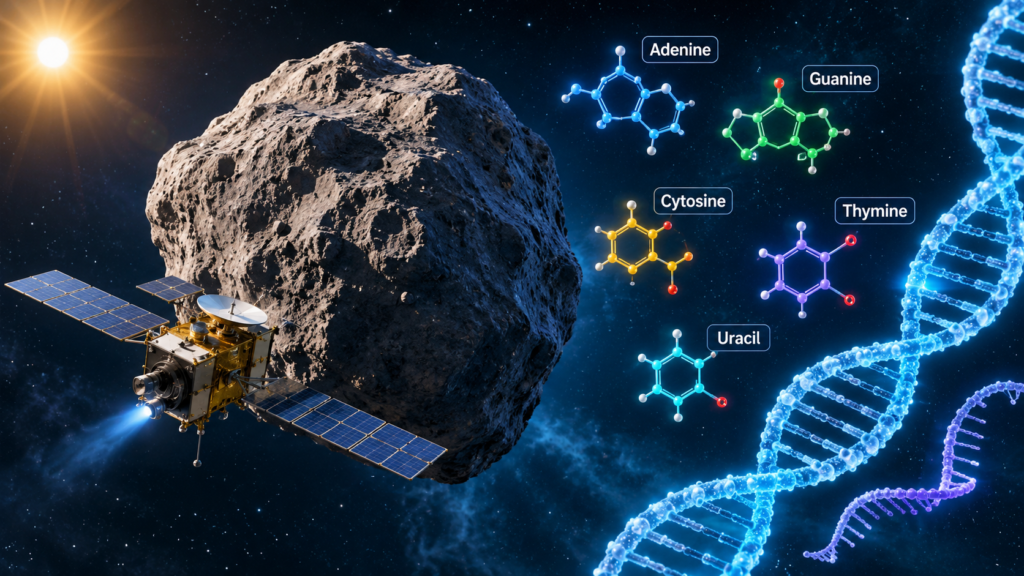
Ryugu asteroid nucleobases have given scientists new clues about the organic chemistry of the early Solar System. Researchers found all five nucleobases used in DNA and RNA in samples collected from the asteroid. The material was brought back to Earth by Japan’s Hayabusa2 spacecraft, and the findings were published in Nature Astronomy on March 16, 2026. The discovery suggests that some chemical ingredients associated with life can exist naturally in space, although it does not mean scientists have found life beyond Earth.
What Do Ryugu Asteroid Nucleobases Reveal About the Origins of Life?
The research identified all five canonical nucleobases found in Earth’s genetic systems.
| Nucleobase | DNA | RNA |
| Adenine | Yes | Yes |
| Guanine | Yes | Yes |
| Cytosine | Yes | Yes |
| Thymine | Yes | No |
| Uracil | No | Yes |
Nucleobases are nitrogen-containing molecules that form part of nucleotides. Nucleotides also contain a sugar and a phosphate group and are the building units of DNA and RNA.
The researchers also detected other purine compounds, including hypoxanthine and xanthine. These are not among the five canonical DNA and RNA nucleobases, although they are relevant to prebiotic chemistry and nucleotide synthesis.
The distinction matters because the discovery concerns individual chemical compounds rather than complete genetic material.
How Scientists Studied the Ryugu Samples
The research team analyzed two aggregate samples from Ryugu, identified as A0480 and C0370.
The samples were allocated through Japan Aerospace Exploration Agency’s third sample-selection opportunity. Their respective masses were approximately 11.9 milligrams and 8.3 milligrams.
Researchers first extracted soluble compounds using water. They then treated the remaining material with hydrochloric acid to recover additional compounds.
The team used several advanced analytical techniques, including high-performance liquid chromatography coupled with electrospray ionization high-resolution mass spectrometry (HPLC/ESI-HRMS).
They also used an alternative separation column, tandem mass spectrometry for selected compounds, and capillary electrophoresis coupled with high-resolution mass spectrometry to strengthen their identifications.
By comparing the results with authentic chemical standards and checking procedural blanks, the researchers obtained evidence supporting the presence of all five canonical nucleobases in the Ryugu material.
The use of returned asteroid samples is particularly valuable because scientists can examine their chemical composition in specialized laboratories without relying only on observations made by spacecraft instruments.
Ryugu Samples Contained Different Amounts of Nucleobases
One important finding was that the two Ryugu samples did not contain identical amounts of nucleobases.
The researchers measured the following total concentrations:
| Sample | Total nucleobase concentration |
| A0480 | 507 ± 21 pmol/g |
| C0370 | 1,577 ± 35 pmol/g |
The C0370 sample contained approximately three times the total nucleobase concentration measured in A0480.
These measurements represent the combined nucleobase concentrations recovered through water and hydrochloric acid extraction.
The researchers also found differences in the relative abundance of individual compounds. For example, guanine in the hydrochloric acid extract was the most abundant nucleobase measured in the C0370 sample.
Such variations show that organic chemistry can differ between samples collected from the same asteroid.
The researchers noted that these differences are consistent with variations reported for other water-soluble organic compounds in earlier Ryugu sample studies.
What the Discovery Reveals About the Chemistry of Asteroids
The Ryugu findings are important because they add to evidence that carbon-rich asteroids contain a diverse range of organic compounds.
Scientists have previously identified organic molecules in meteorites and other extraterrestrial materials. However, the relative amounts of different nucleobases can vary between samples.
The research compared Ryugu with material from asteroid Bennu and two carbonaceous meteorites, Orgueil and Murchison.
The comparisons revealed different chemical patterns:
- Ryugu contained nearly equal overall amounts of purines and pyrimidines.
- Bennu and Orgueil showed a greater relative abundance of pyrimidines.
- Murchison showed a greater relative abundance of purines.
These differences suggest that the chemical environments experienced by different asteroid and meteorite parent bodies influenced the formation and distribution of organic compounds.
The comparison is important because it suggests that nucleobase chemistry was not identical throughout the early Solar System.
Research into organic compounds in space is also helping scientists understand the chemistry of the early universe. Another example is the discovery of fully deuterated methanol in space, which offers further insight into how complex molecules can exist beyond Earth.
Researchers Investigate a Possible Connection Between Ammonia and Nucleobase Formation
Another interesting part of the study involved ammonia.
The researchers compared purine-to-pyrimidine ratios with free ammonia concentrations across samples from Ryugu, Bennu and Orgueil.
They reported a negative correlation with an R² value of 0.89. In the examined samples, higher ammonia concentrations were associated with lower purine-to-pyrimidine ratios.
This observation led the researchers to propose that ammonia availability may have influenced the chemical pathways responsible for producing different nucleobases in asteroid parent bodies.
The proposed explanation involves the availability of different chemical starting materials, including carbon-containing compounds, nitrogen-containing compounds and cyanides.
However, the relationship has not yet been experimentally established as a general mechanism. The researchers specifically noted that the influence of ammonia concentration on purine and pyrimidine formation still requires further investigation.
This makes the finding an important direction for future prebiotic chemistry research rather than a settled explanation.
Does Finding DNA and RNA Nucleobases Mean Scientists Found Life in Space?
No. Detecting nucleobases is not the same as discovering DNA, RNA, living cells or microorganisms.
Nucleobases are individual chemical compounds. They can exist through non-biological chemical processes and do not require the presence of living organisms.
The Ryugu study demonstrates that all five canonical nucleobases can occur together in material from a carbon-rich asteroid.
It does not show that Ryugu ever supported life, nor does it prove that life on Earth originated in space.
Instead, the discovery supports the possibility that extraterrestrial materials contributed organic compounds to the chemical inventory of the early Earth.
Understanding how these compounds formed, survived and interacted with other molecules is an important part of investigating the origin of life.
What Could Scientists Investigate Next?
The Ryugu findings create new opportunities to study how nucleobases form under different conditions in space.
Researchers can compare more asteroid and meteorite samples to investigate why some extraterrestrial materials contain higher proportions of purines while others contain more pyrimidines.
Future experiments could also examine how ammonia, cyanides, water and other chemical starting materials influence nucleobase formation.
Studying the isotopic composition of these compounds may provide additional information about their origins and the chemical processes that produced them.
Samples returned from Ryugu and Bennu offer particularly valuable opportunities because scientists can perform detailed laboratory analyses on material collected directly from asteroids.
Further research may help establish how widespread these compounds are throughout the Solar System and whether asteroids played a significant role in supplying prebiotic ingredients to early Earth.
Conclusion
The detection of all five canonical DNA and RNA nucleobases in asteroid Ryugu is an important finding in the study of extraterrestrial organic chemistry.
The research identified adenine, guanine, cytosine, thymine and uracil in two samples returned by Japan’s Hayabusa2 mission. It also revealed differences in nucleobase concentrations and distributions, offering clues about the chemical environments of asteroid parent bodies.
The findings do not prove that life exists beyond Earth or that life originated in space. However, they strengthen the evidence that important chemical compounds associated with genetic systems can form or survive in extraterrestrial environments.
As researchers continue studying asteroid samples, they may gain a better understanding of how the chemical ingredients associated with life became available in the early Solar System.
Frequently Asked Questions
What five nucleobases were found in asteroid Ryugu?
Scientists detected adenine, guanine, cytosine, thymine and uracil in samples returned from asteroid Ryugu.
When was the Ryugu nucleobase study published?
The research was published in Nature Astronomy on March 16, 2026.
Did scientists find complete DNA or RNA on asteroid Ryugu?
No. Researchers identified individual nucleobases, not complete DNA or RNA molecules.
How much nucleobase material was found in Ryugu samples?
The total measured nucleobase concentrations were 507 ± 21 pmol/g in sample A0480 and 1,577 ± 35 pmol/g in sample C0370.
What spacecraft collected the Ryugu samples?
Japan’s Hayabusa2 spacecraft collected material from Ryugu and returned it to Earth in December 2020.
Does the discovery prove that life exists elsewhere in the universe?
No. Nucleobases can form through non-biological chemical processes. Their presence does not demonstrate the existence of extraterrestrial life.
Why is the discovery important for origin-of-life research?
It shows that all five canonical nucleobases can occur in carbon-rich asteroid material. This helps scientists investigate how organic compounds associated with genetic systems may have become available on the early Earth.
Sources
- Koga et al., A complete set of canonical nucleobases in the carbonaceous asteroid (162173) Ryugu, Nature Astronomy, March 16, 2026.
https://doi.org/10.1038/s41550-026-02791-z - Japan Aerospace Exploration Agency (JAXA), Hayabusa2 mission.
https://www.hayabusa2.jaxa.jp/en/ - NASA, OSIRIS-REx mission.
https://science.nasa.gov/mission/osiris-rex/
