
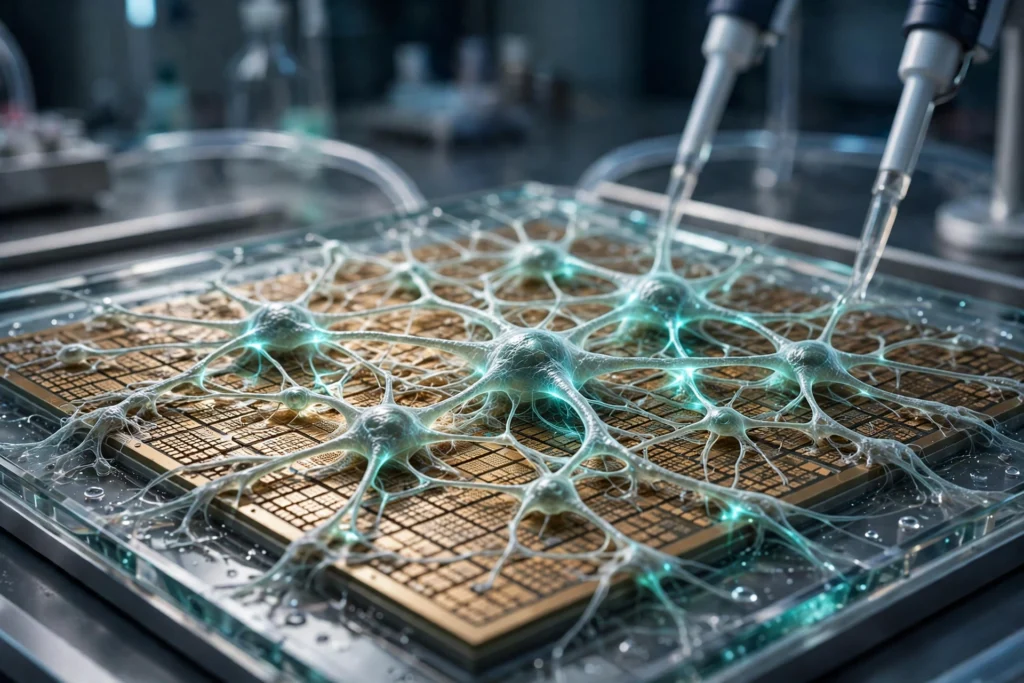
Introduction
What if a computer could use living brain cells to process information? That is the idea behind a wetware computer, an experimental type of computing system that combines living neurons with electronic hardware and software.
One example is the CL1, developed by Australian company Cortical Labs. In early 2026, a demonstration showed a system using around 200,000 living human neurons grown on a chip interacting with Doom, the classic first-person shooter. The experiment offered a striking example of how biological neural networks can connect with a digital environment, although it does not mean the cells play or understand a game like humans do. (Scientific American)
Wetware computing is also being explored beyond individual experiments. In August 2026, Cortical Labs, DayOne and the National University of Singapore unveiled a biological data-centre prototype built around 20 CL1 units.
These developments raise an intriguing question: could living neurons eventually help researchers develop new approaches to computing, AI and scientific research?
What Is a Wetware Computer?
A wetware computer is a computing system that incorporates biological material, particularly living neurons, to perform certain information-processing tasks. The term combines the ideas of hardware, software and biological systems.
Traditional computers process information through electronic circuits made from semiconductor materials. Wetware computers instead use networks of living neurons that respond to electrical stimulation and produce measurable electrical activity.
The neurons do not operate independently of electronics. They are connected to specialised interfaces that deliver signals, record their responses and allow software to interpret their activity.
Wetware computing is closely related to biological computing, brain-on-a-chip research and experimental forms of neural computing. However, these terms do not always describe identical technologies.
The goal is not to recreate a complete human brain inside a computer. Researchers are investigating whether living neural networks can perform particular tasks, adapt to changing inputs and provide useful insights into biological learning.
How Does the CL1 Wetware Computer Work?
Cortical Labs developed the CL1 as a biological computing system that combines lab-grown neurons with silicon hardware and electronic interfaces.
Its operation can be understood through four main stages.
1. Growing living neurons
Researchers grow neurons from human stem cells under controlled laboratory conditions. These cells develop into networks capable of producing electrical activity.
These are laboratory-grown cells, not a complete human brain. The system does not contain a human mind or a person’s complete memories.
2. Connecting neurons to a silicon chip
The neurons are placed on a specialised interface containing electrodes. These electrodes allow the system to deliver electrical stimulation to the neural network and record its responses.
The silicon hardware is essential because it provides the interface between living cells and the digital environment.
3. Sending information to the neural network
Software translates information from a task into electrical stimulation patterns. The neurons respond with patterns of electrical activity, which the system records and interprets.
This creates a feedback loop between the digital task and the biological network.
4. Interpreting the responses
The recorded neural activity is translated into outputs that can affect the task being performed.
Researchers can adjust stimulation and feedback to influence how the network responds. This makes it possible to investigate adaptive behaviour in a controlled computing environment.
The important distinction is that the neurons do not run ordinary computer programs in the same way a CPU executes instructions. Biological activity and electronic processing work together.
How Did a Wetware Computer Play Doom?
In early 2026, Cortical Labs demonstrated that its CL1 biological computer could control the classic video game Doom using electrical signals exchanged with living human neurons grown on a chip. The demonstration used approximately 200,000 neurons and showed an experimental approach to biological computing, not a system capable of playing the game like a human. (Scientific American)
How the Doom demonstration worked
The basic process involved three connected elements:
- Game information: The digital environment supplied information about what was happening in the game.
- Neural stimulation: The information was converted into electrical patterns that could stimulate the living neural network.
- Recorded responses: Electrical activity from the neurons was interpreted and translated into actions within the game.
Feedback helped shape the network’s behaviour over time.
This experiment builds on earlier work in which biological neural networks were trained to interact with simpler environments, including the game Pong.
However, playing Doom does not mean that the neurons understand the game’s story, graphics or objectives as a person does. It demonstrates a form of interaction between a biological neural network and a digital task.
Research source: Scientific American — How Human Neurons on a Chip Learned to Play Doom
Wetware Computers and Biological Data Centres
Wetware computing is also being explored as a possible component of future computing infrastructure.
In August 2026, the National University of Singapore’s Yong Loo Lin School of Medicine, DayOne and Cortical Labs unveiled a biological data-centre prototype at the NUS Life Sciences Institute.
The prototype uses a 20-unit CL1 biological computing system in a research environment. It combines living neural networks with electronic computing hardware and infrastructure designed to support further development.
The project is significant because it moves biological computing towards a multi-unit installation rather than focusing exclusively on a single laboratory device.
The partners are exploring potential applications in areas such as biomedical research, drug discovery, neurological disease research and selected AI-related tasks.
However, the prototype is not evidence that conventional data centres can already be replaced by biological systems. Its capabilities and practical applications still require further testing and development.
Official source: NUS Medicine — Biological Data Centre Prototype in Singapore
Could Wetware Computers Make AI More Energy-Efficient?
Energy consumption has become an important consideration as AI systems and data centres grow.
Conventional AI workloads often rely on processors that perform large numbers of mathematical operations. Wetware computing takes a different approach by incorporating the activity of living neural networks into information processing.
Biological neurons consume energy and operate through electrochemical processes. Researchers are interested in whether these properties could provide advantages for certain specialised tasks.
Potential benefits being investigated include:
- Adaptive processing: Neural networks may change their responses through stimulation and feedback.
- Alternative computing methods: Biological systems could offer approaches that differ from conventional digital processing.
- Scientific modelling: Living neural networks may help researchers investigate biological learning and responses to different conditions.
- Specialised AI research: Biological computing could eventually complement some existing computational approaches.
However, claims about energy efficiency require careful comparisons. The power used by the neural network alone is not the same as the total energy needed to operate a complete system.
Electronics, stimulation equipment, monitoring, environmental control and cell maintenance may all contribute to the overall energy requirement.
There is not yet sufficient public evidence to conclude that wetware computers are generally more energy-efficient than conventional computers across equivalent real-world workloads.
For now, their potential advantages remain an active area of research.
What Could Wetware Computing Be Used For?
Wetware computing is still an emerging field, but several research directions are worth following.
1. Studying learning and neural activity
Researchers can observe how living neural networks respond to different stimulation patterns and feedback. This may help improve understanding of biological learning and adaptation.
2. Drug discovery and neurological research
Biological computing platforms may eventually support experiments that investigate how neural systems respond to compounds or other interventions.
These applications would require appropriate scientific validation. A neural network on a chip is not a complete substitute for clinical studies or the human brain.
3. Exploring alternative AI systems
Researchers are investigating whether biological neural networks could complement existing AI technologies in selected tasks.
This does not mean that wetware computers can currently replace large language models, GPUs or mainstream AI infrastructure.
4. Developing new computing architectures
Combining biological networks with electronic systems could lead to new ways of designing specialised computing devices.
The practical value of these systems will depend on their reliability, scalability, cost, maintenance requirements and performance on clearly defined tasks.
Wetware Computer vs Traditional Computer
| Feature | Wetware computer | Traditional computer |
| Main computing element | Living biological neurons integrated with electronics | Electronic circuits and semiconductor processors |
| Information processing | Neural activity combined with electronic interfaces | Digital operations executed by processors |
| Programming and control | Software, stimulation and feedback systems | Programs executed by hardware and operating systems |
| Biological maintenance | Living cells require controlled conditions | No living cells are required |
| Current applications | Experimental research and specialised demonstrations | Everyday computing, gaming, business and AI |
| Main limitation | Immature technology and uncertain scalability | Energy, cost and hardware limitations vary by workload |
This comparison describes the general approaches. Wetware systems still depend on conventional electronics, and their performance cannot be compared fairly with traditional computers without specifying the task and measurement.
What Are the Limitations of Wetware Computers?
Despite the attention surrounding CL1, several challenges remain.
Keeping neurons alive
Living cells need suitable environmental conditions, nutrients and maintenance. This creates requirements that conventional silicon chips do not have.
Controlling and interpreting neural activity
Neural networks produce complex patterns of electrical activity. Turning these responses into reliable and repeatable outputs is a major engineering challenge.
Scaling the technology
A successful demonstration does not automatically establish that a system can support large commercial workloads. Researchers must determine how biological computing systems can be expanded and operated reliably.
Measuring real-world performance
A system that completes a particular experimental task may not outperform conventional computers at other tasks. Fair comparisons require equivalent workloads and transparent measurements.
Understanding biological variability
Living cells can differ in their responses. Researchers need ways to account for this variability when developing reliable computing systems.
These challenges help explain why wetware computing should currently be viewed as an emerging research and technology area rather than a replacement for everyday computers.
Does a Wetware Computer Have a Human Brain?
No. A wetware computer such as CL1 uses living neurons grown in a laboratory, but it is not a complete human brain.
The system does not have the full structure of a human brain, and its ability to respond to stimulation should not be interpreted as evidence of human-like consciousness, intelligence or understanding.
The Doom demonstration shows that living neural networks can interact with a digital environment through carefully designed electronic interfaces. It does not establish that the neurons experience the game or understand it as a human player would.
Distinguishing measurable biological activity from claims about consciousness is important when evaluating this technology.
What Is the Future of Wetware Computers?
The future of wetware computing will depend on whether researchers can demonstrate practical advantages beyond experimental tasks.
The CL1 Doom demonstration showed one way to connect living neurons to a digital environment. The Singapore biological data-centre prototype represents another development: integrating multiple biological computing units into a research infrastructure.
Together, these projects provide evidence that biological computing is progressing beyond purely theoretical discussion.
Future research will need to establish which tasks benefit from biological neural networks, how consistently these systems perform, what they cost to operate and whether their advantages justify their specialised requirements.
Wetware computers may eventually complement conventional computing in selected areas of research or specialised information processing. However, their long-term role remains uncertain.
Frequently Asked Questions
What is a wetware computer?
A wetware computer is a computing system that uses living biological material, such as neurons, alongside electronic hardware to process information.
Can a wetware computer play Doom?
Yes. In early 2026, Cortical Labs demonstrated its CL1 biological computing system interacting with Doom using approximately 200,000 living human neurons connected to electronic hardware.
How many neurons does the CL1 use?
The Doom demonstration used around 200,000 living human neurons, according to reporting by Scientific American. The same publication reports that a CL1 unit can house approximately 800,000 neurons. These figures describe the reported Doom demonstration and the unit’s reported capacity, respectively, and should not be treated as the same measurement. (Scientific American)
Is a wetware computer the same as a human brain?
No. A wetware computer uses laboratory-grown neural networks connected to electronic interfaces. It is not a complete human brain and does not automatically possess human-like consciousness or understanding.
Can wetware computers replace traditional computers?
Not at present. Wetware computing remains an emerging technology, and there is insufficient evidence that it can broadly replace conventional processors, PCs or AI infrastructure.
Are wetware computers more energy-efficient than normal computers?
They may offer advantages for certain tasks, but broad claims about energy efficiency require transparent comparisons that include the electronics and infrastructure needed to maintain and operate the biological system.
What is a biological data centre?
A biological data centre is a computing installation that incorporates biological computing systems, such as CL1 units, into a larger technical environment. Singapore’s 2026 prototype demonstrates this approach in a research setting.
What could wetware computers be used for in the future?
Potential areas include research into biological learning, biomedical modelling, drug discovery and specialised computing applications. These possibilities require further investigation and validation.
Final Thoughts
Wetware computers offer a different approach to computing by combining living neurons with electronic hardware. Cortical Labs’ demonstration of a neural network playing Doom and the 2026 Singapore biological data-centre prototype show that the technology has progressed beyond a purely theoretical concept.
Nevertheless, important questions remain about reliability, scalability, energy consumption and practical applications.
For now, wetware computing is best understood as an emerging field that may complement conventional computing in selected areas, rather than replace the computers people use today.
As research develops, the most important question will not simply be whether living neurons can perform a computing task, but whether they can do so reliably, safely and usefully enough to solve real-world problems.
